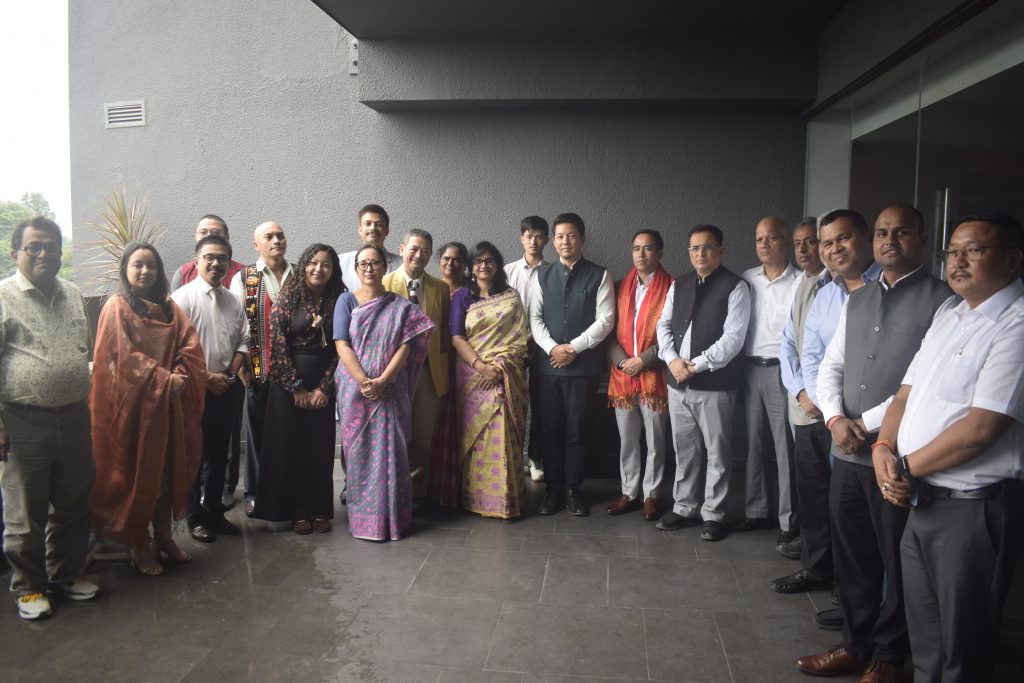
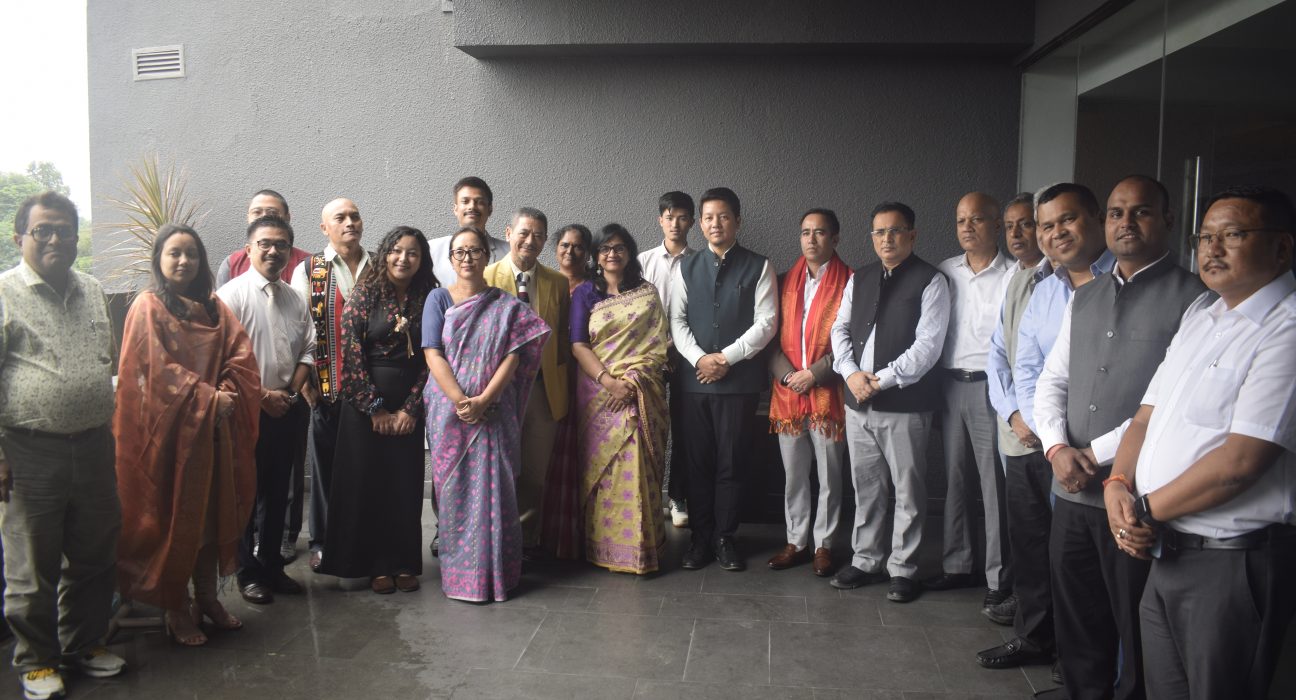
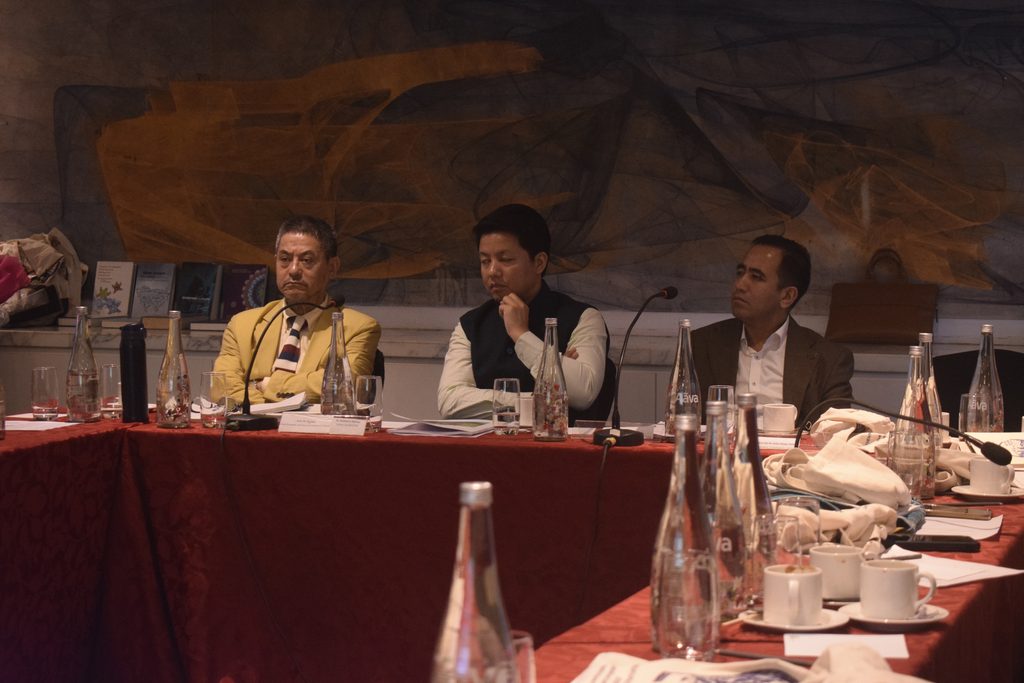
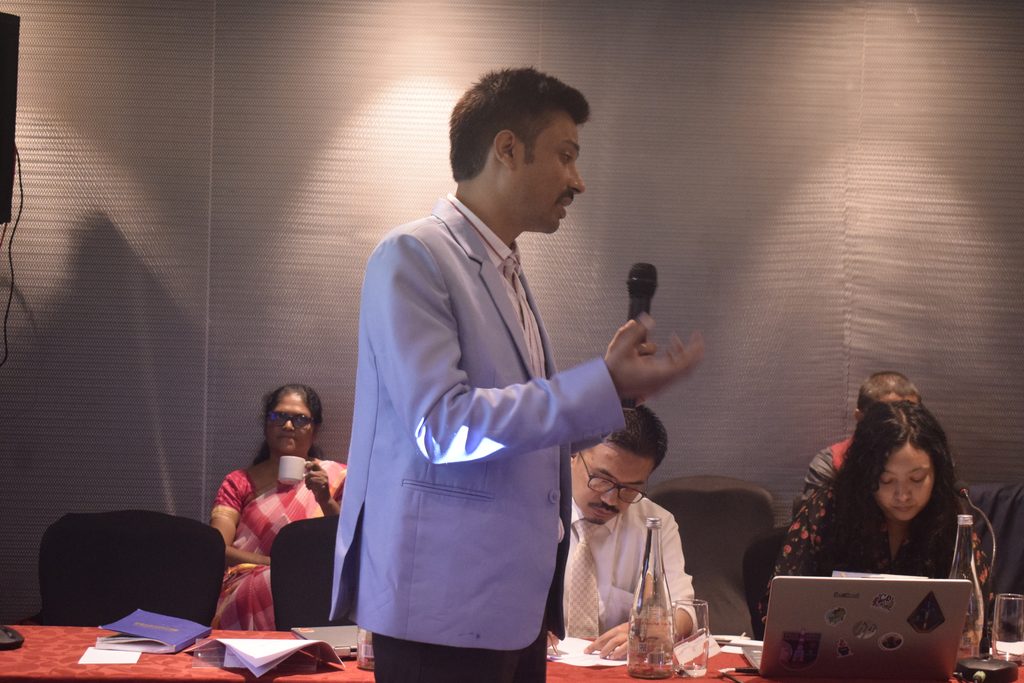
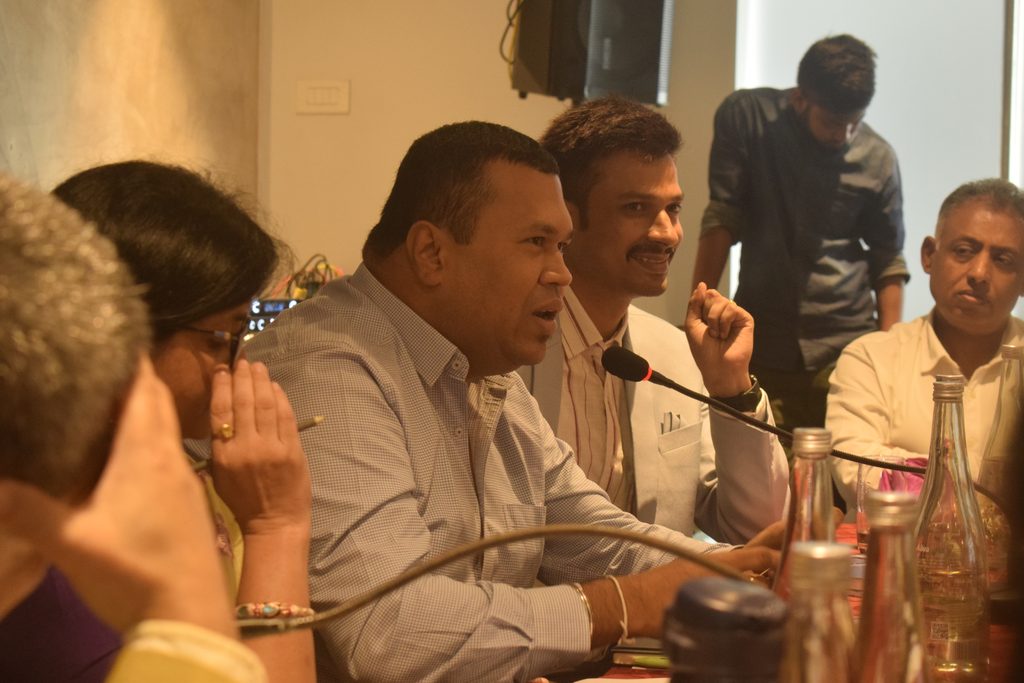
The dialogue brought together legislators, water-resource practitioners, researchers, academics and policy stakeholders to deliberate on spring-source security, springshed governance, institutional convergence and the integration of scientific and traditional knowledge systems in the Eastern Himalayas.
Dr. Kabindra Sharma, Fellow at SaciWATERs, while presenting the “Muhan Bachau Abhiyan and Local to Global” initiative, emphasised the need to strengthen source-level interventions and translate community-based water conservation practices into broader policy frameworks.
“We often speak about the Himalaya as the source of some of the great rivers of South Asia. Yet, at the community level, it is often much smaller and more fragile water systems, particularly springs, streams and local catchments, that sustain everyday life. For mountain communities, development cannot be separated from the natural systems that sustain them. – Dr. Jayati Chourey, Executive Director, SaciWATERs.
Member of Parliament Indra Hang Subba highlighted the limited representation of Himalayan constituencies in Parliament and observed that the region’s water-security concerns require stronger institutional mechanisms within the parliamentary policy process. He suggested that Parliamentary Standing Committees could play a greater role in scrutinising and influencing policies and programmes formulated at the Union level.
Subba also raised concerns regarding the implementation of the Jal Jeevan Mission (JJM), stating that infrastructure-led interventions cannot ensure drinking-water security when the underlying spring sources are depleted or located far from settlements. He stressed the need to shift emphasis from household-level piped-water connectivity towards source sustainability and springshed management.
He further referred to the Pradhan Mantri Krishi Sinchayee Yojana (PMKSY), suggesting that greater inter-departmental coordination and parliamentary oversight could facilitate stronger integration of source conservation into water-resource planning.
Sikkim’s Dhara Vikas programme was cited as an important regional example of springshed rejuvenation. Sirinadam in West Sikkim was identified as one of the early sites where the programme was implemented and continues to be pursued.
Speakers noted that springshed management in the Himalayan region involves complex land-tenure, hydrogeological and institutional challenges. Implementation on privately owned land requires appropriate consent and institutional mechanisms, while interventions within forest areas require coordination and statutory support from the Forest Department.
Professor Mahendra P. Lama emphasised the need to address the hydrogeological and socio-cultural dimensions of spring depletion. Referring to the concept of “Mool Phutnu”, the natural emergence or resurgence of spring sources, he observed that the traditional understanding of springs and their ecological significance is gradually disappearing.
Lama pointed to the interconnected hydrology of the Eastern Himalayan region, observing that “international regions are brought together by the hydrology of springs.” He called for systematic scientific inventorying and hydrogeological mapping of springs across Sikkim and Darjeeling, alongside documentation of traditional ecological knowledge.
He also underlined the need to move beyond conventional belief-based approaches and strengthen scientific understanding of spring systems. According to him, one of the major challenges remains the application of scientific research at the community and institutional levels and its effective convergence with traditional knowledge systems.
Concerns were also raised over the increasing privatisation and commercialisation of spring water, including the extraction and sale of spring water by private individuals and institutions. Speakers called for an appropriate regulatory framework to address ownership, access, extraction and commercial utilisation of spring resources.
The dialogue further stressed the need to integrate legal, technical and administrative mechanisms within urban local bodies, municipalities, panchayats and other decentralised governance institutions.
Prof. Lama called for regional mechanisms to manage water-related conflicts and facilitate cross-border knowledge exchange among Himalayan communities. Lessons from Sikkim were noted to have informed springshed initiatives in Nepal and Bhutan, particularly through knowledge exchange on Dhara Vikas and community-based spring rejuvenation.
A representative from the International Centre for Integrated Mountain Development (ICIMOD), Nepal, noted that springshed systems differ fundamentally from conventional watershed approaches and require a distinct hydrogeological and governance framework. The representative highlighted the importance of co-learning, adaptive management and the integration of scientific, traditional and community knowledge.
The representative also observed that significant spring-related data remains housed within government departments and is not adequately disseminated to communities, researchers and other stakeholders. Greater data accessibility and institutional knowledge-sharing were identified as essential components of evidence-based springshed governance.
Kurseong MLA Sonam Lama highlighted the need for greater legislative representation and stronger policy advocacy concerning Himalayan water security. Speakers noted that although substantial financial resources are available under the Jal Jeevan Mission, allocating a greater proportion of resources towards source protection, recharge and long-term spring sustainability could strengthen the effectiveness of drinking-water interventions.
The participants also advocated convergence among four key departments: PHE, Forest, RDD and UDD, and recommended presenting relevant scientific research and field evidence before the West Bengal Legislative Assembly to support evidence-based policy formulation.
An Additional Director from the Public Health Engineering Department, Government of Sikkim, highlighted the potential application of springshed management to urban water-security challenges. He noted that systematic springshed interventions could potentially augment water availability in urban centres such as Gangtok and Namchi.
Prof. Mahendra P Lama proposed a comprehensive review and redesign of existing spring-rejuvenation models, along with the development of a new hydrogeological framework centred on the concept of “spring sanctuaries.” He referred to the importance of understanding unconfined aquifer systems and their relationship with spring discharge and recharge zones.
Representatives associated with the Brahmaputra Water Conservation Board emphasised the need for stronger grassroots participation in water-conservation programmes. The discussion also referred to proposals under consideration for Sikkim and Darjeeling, including two proposals for Sikkim and 18 for Darjeeling.
The policy dialogue concluded with an emphasis on moving from fragmented spring-rejuvenation interventions towards integrated springshed governance involving hydrogeological assessment, source protection, aquifer recharge, community participation, institutional convergence, data-sharing and policy-level coordination across the Eastern Himalayan region.
Earlier, on October 03, a meeting was organized on theme: urgent need to protect drying springs and secure water for mountain communities took center stage at a multi-stakeholder dialogue. The meeting brought together 42 participants from 25 organisations, including government officials, researchers, civil society organisations, municipal and forest officials, media representatives and tourism practitioners.
The dialogue focused on practical solutions and stronger institutional coordination for protecting mountain water sources.
The objective of the event incorporates the growing water security challenge of drying up of springs across the Darjeeling-Sikkim Himalayas. And the stakeholders call for a national policy framework on spring governance.
Dr. Kabindra Sharma, Fellow, SaciWATERs, highlighted declining water availability and the dependence of mountain communities on springs. He stressed that water security requires more than delivery infrastructure, calling for the scientific spring mapping, protection of recharge areas, appropriate rejuvenation measures and meaningful community participation.
He referred to NITI Aayog’s 2018 assessment, which indicated that nearly 30% of springs in the Indian Himalayan Region had dried up and around 50% had experienced declining discharge.
Dr. Jayati Chourey, Executive Director, SaciWATERs, emphasised that alongside infrastructure, water security is shaped by ecosystems, institutions and people.
Dr. Ghanshyam Sharma of Sikkim shared lessons from the state’s Dhara Vikas program, highlighting hydrogeological understanding, recharge-zone identification and scientific approaches, including radioisotope studies.
Dr. Subash Dhakal, Deputy Director, Land and Revenue, Government of Sikkim, highlighted the need for dedicated financing and locally appropriate springshed management.
Sambarta, Range Forest Officer, Kurseong, emphasised ecologically appropriate forest management, while Pramod Giri of Himal World stressed public awareness on water shortages.
During a group discussion the participants called for a coherent national policy framework for the protection and governance of springs and their recharge areas across the Indian Himalayan Region. This has become a need of the time which has highlighted the critical moment to the water security and livelihoods of an estimated 50 million people.
They recommended clearly defined institutional responsibilities, stronger interdepartmental coordination, dedicated financing, integration of springshed management into existing water programmes, and recognition of community-led conservation and Indigenous knowledge.
The recommendations will inform a policy dialogue on October 08, bringing elected representatives and senior policymakers together to identify actionable priorities for springshed governance.
The central message was clear: mountain water security depends not only on delivering water through pipes and infrastructure, but also on protecting the springs and landscapes that sustain it.
About The Himali Journal
The Himali Journal - People, Place and Culture is an independent digital publication dedicated to documenting the diverse stories, landscapes, traditions, and communities of the Himalayan region.
Founded with a commitment to meaningful storytelling, The Himali Journal explores the lives of people, the character of places, and the richness of culture across the eastern Himalayas and beyond. Our coverage spans Sikkim, Darjeeling, Kalimpong, Siliguri, the Dooars, and other mountain and foothill regions where heritage, identity, and change intersect.
We believe that every community has stories worth preserving. Through feature articles, interviews, photo essays, documentaries, travel narratives, cultural reports, and environmental journalism, we seek to record voices that are often overlooked by mainstream media.
Our Focus
People
Stories of individuals, communities, livelihoods, traditions, achievements, and everyday life.
Place
Explorations of villages, towns, landscapes, sacred sites, heritage locations, and destinations that shape regional identity.
Culture
Documentation of festivals, oral histories, indigenous knowledge, language, art, music, cuisine, rituals, and living traditions.
Our Mission
To create an accessible archive of Himalayan life by producing accurate, thoughtful, and visually engaging journalism that informs, educates, and inspires future generations.
Our Vision
To become a trusted platform for documenting and celebrating the human and cultural diversity of the Himalayan region while encouraging dialogue, understanding, and preservation of local heritage.
At The Himali Journal, we believe that understanding a region begins with understanding its people, its places, and its culture.
The Himali Journal
People, Place and Culture