


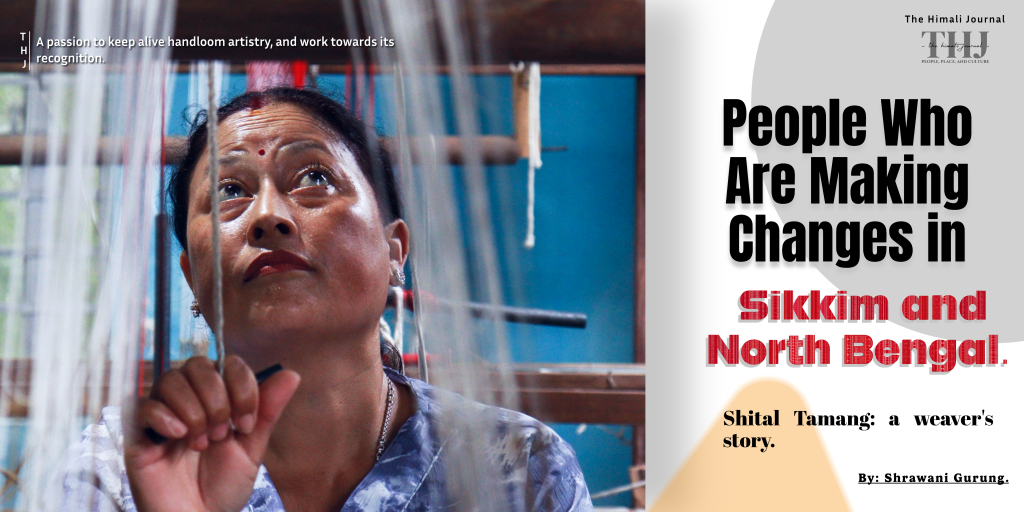



Shital Tamang National Handloom Award Winner Story
Shital Tamang, a local of Upper Gom, Namchi engaged in the handloom business in South Sikkim received the National Handloom Award 2025, for Lepcha Daree under category of ‘Tribal Weaves’, from President Draupadi Murmu on 7th August 2026 during the 12th National Handloom Day held at Rastrapati Bhavan Cultural Centre, New Delhi.
Start of the journey
In 2012, with a short training provision provided by the Directorate of Handicrafts and Handloom (DHH), Shital Tamang along with nineteen other women had received a training in Gom ward. The two months, training was he first time she was introduced to handloom and handicraft. At the time she was only 28 years old. Although many other women had taken this training along with her, she was one of the few who carried on with the practices. As a daughter of Sikkim, she had always wished to bring recognition of her cultural identity and conserve this tradition.
Hardships
In 2017, Shital Tamang was diagnosed with a tumor which had left her shaken. Since the treatment couldn’t be performed in Sikkim, multiple visits had to be made over the next two years in a hospital in Delhi. In 2019, reports revealed a requirement for a lifetime treatment. With the strike of the COVID-19 epidemic she was unable to return back to Sikkim for three months. And the doctor visits became irregular. Despite these events, her mind was set on continuing with handloom and handicraft. Which had now become her family business. With a slight improvement in her health, she continued her work alongside her husband in her centrein Gom. While also starting to take her radiation treatments again.
Encouraging local participation
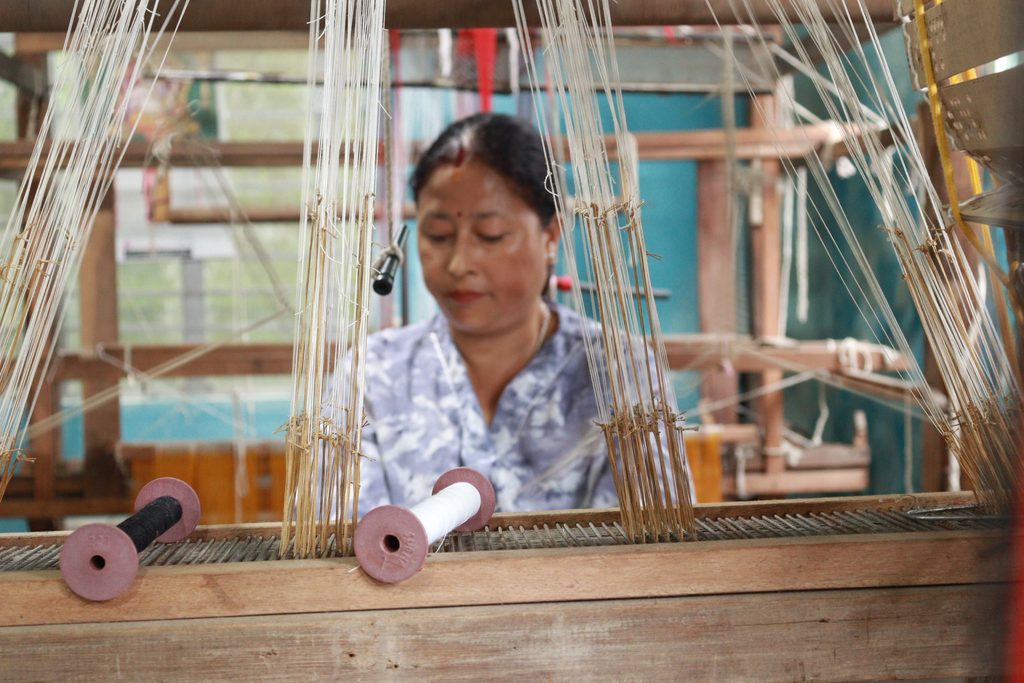
The Handloom Industry in Sikkim is not a recognized business. And despite the DHH providing trainings all over Sikkim the participation is seen scarce. Eventually, being amongst a few practitioners to continue with the craft, Shital Tamang became a known name in the department. Although she received daily support from her family, she could no longer do it alone. Moved by her efforts, the nearby women came forward to take part in this practice although they had not received any prior training. Now Shital Tamang has a well-established team of 17 weavers, most of whom are locals of Upper Gom.
Family support
With the participation of the local women, the business started to take off. However, managing a designer was costly and complicated. That is when she made a bolder decision of sending her own son for the designer’s course. Although her son opted to go for accountancy her son went for the Textile Industry instead. Which proved to be fruitful. She dedicates her success to the hard work of the local women and her children. Throughout her journey, her husband, to whom she strongly expresses her gratitude to, acted as her backbone. Till date all the technical work is handled by her husband and he too has gained the knowledge of handloom over the years.
Government schemes for the weavers
The Directorate of Handloom and Handicrafts (DHH) is continuously providing training programs to promote the practice of handloom in Sikkim. And looms were provided to all the weavers by the Loom Department. Initially, Shital Tamang also received a sum of rupees ₹25,000 to build a house which she used to build a homestay. And with the counsel of her husband, she aimed her Centre to simultaneously act as a tourist attraction. The children of the weavers under the National Handloom Development Programme (NHDP) Scholarship Component are also offered financial assistance of up to ₹2,00,000/- annually. This support covers tuition, admission, and examination fees at recognised textile institutions.
Experience outside Northeast
Having low product demand locally, she began selling her products in Gangtok and outside of Northeast. Despite having a problems of language barrier, people welcomed the handloom art with curiosity and appreciation. A common language ground was a necessity since the story behind the art was important for their sale. Handloom art of Sikkim was a new discovery to the people from outside of Northeast. Which Shital Tamang thought indicated the need for the art to be recognized.
Future Plans
Receiving the Lepcha Daree Award in 2026 is only a milestone in her journey for the tradition of handloom artistry in Sikkim. Shital Tamang wishes to set up a distinctive industry for such craft in South Sikkim which would help it gain recognition accepted by all.