

“Stigma Kills More Than Drugs”: Aie Rinzing’s Journey Through Addiction and Recovery
Addiction and Recovery | Episode 3 of 3
In this episode, Aie Rinzing shares her journey through drug addiction, stigma, and recovery, highlighting the hidden struggles female users face in seeking rehabilitation.
“It is a hell.” Aie Rinzing pauses before she says it again, as if language itself struggles to hold the weight of her memory.
Today, she smiles easily. She speaks with calm clarity. She says she is grateful. For sleep, for food, for the simple ability to feel like herself again.
But the road that brought her here was long, painful, and marked by something more suffocating than addiction itself: stigma.
This article is intended for awareness and educational purposes only. It does not promote or glorify drug use. The experiences shared are personal accounts of recovery.
If you or someone you know is struggling, seek help. You are not alone.
If you are struggling with substance abuse, consult a qualified medical professional or rehabilitation centre. Do not attempt withdrawal without supervision.
(Read Episode 1: A recovering drug user’s story)
A Meeting in MG Marg
We meet at a café along MG Marg on a Sunday evening in March. The street is alive, as it always is, tourists walking, families chatting, music echoing faintly through the hills.
Inside the café, however, the atmosphere is quieter, more grounded. Several recovering users have gathered.
Conversations are soft but meaningful. There is an unspoken understanding in the room. A shared history of struggle and survival.
We were meant to meet earlier, in February. But schedules didn’t align. Her work kept her busy. And distance, my travel from Namchi to Gangtok, made it difficult.
Recovery, like life, does not always follow a fixed plan.
The Beginning: Friendship and Escape
Twenty-six years ago, Aie Rinzing was introduced to drugs by her friends. It did not begin as rebellion. It began as escape.
Life, she says, was already filled with emotional turmoil. Drugs did not feel dangerous at first. They felt like relief, a temporary silence from the noise within.
“It felt like heaven,” she recalls. That is how addiction often begins. Not in darkness, but in perceived light.
What starts as a small habit quietly grows. Without warning. Without permission. Until one day, it is no longer a choice. It is a need.
The Descent into Addiction
For nearly a decade, Aie Rinzing used brown sugar and heroin. The substances changed her not just physically, but emotionally and psychologically.
Yet, like many users, she did not recognize herself as an addict.
“It was never in my conscience,” she says. Instead of acceptance, there was denial.
“I’m not hurting anyone,” she would tell herself.
That sentence became her shield protecting her from reality. But also trapping her within it. Denial is not ignorance. It is resistance.
And in addiction, resistance delays recovery.
Withdrawal: The Personal Hell
When she speaks about withdrawal, her tone changes.
“It is a hell.”
There is no embellishment. No metaphor. Just truth. Withdrawal stripped her of comfort, control, and identity.
It was not just physical pain. Though that was overwhelming, but a deep psychological collapse.
Sleep disappeared. Appetite vanished. The body rebelled. The mind spiraled. Survival became the only goal.
Recovery, from the outside, is often seen as a moment of transformation. A turning point filled with hope. But for her, the beginning of recovery was anything but beautiful.
The Weight of Guilt
“Guilt is always present,” she says.
It exists in layers. Guilt toward family. Guilt in society. Guilt within oneself. Recovery did not erase the past. It forced her to confront it.
Every relationship carried memory. Every interaction held reflection. Even silence had weight. Yet, within that burden, she found something unexpected: acceptance.
Accepting that she was an addict did not weaken her. It gave her direction. It allowed her to begin again.
The Invisible Barrier: Being a Woman
If addiction is difficult for anyone, for women it is often harder. Aie Rinzing speaks about this without hesitation. Her biggest challenge was not just addiction. It was being a woman addict.
In Sikkim, out of 12 rehabilitation centres, only 3 accept women. That statistic is not just a number. It reflects a deeper issue, access, safety, and social perception.
Women users are fewer in rehabilitation not because they do not exist, but because they are hidden. They fear stigma. They fear judgment. They fear being seen.
“Many don’t come forward,” she says. “Not because they don’t want help, but because of what society will say.” But the cost of seeking help becomes heavier than the cost of suffering.
When Stigma Becomes Fatal
“Many friends died,: she recalls. Some from overdose. Others from suicide.
But what stayed with her was not just their deaths, it was the silence around them.
In many cases, families refused rehabilitation for their children. Not because they did not care, but because they feared social judgment.
“What will the neighbours say?” That question has destroyed more lives than it has protected.
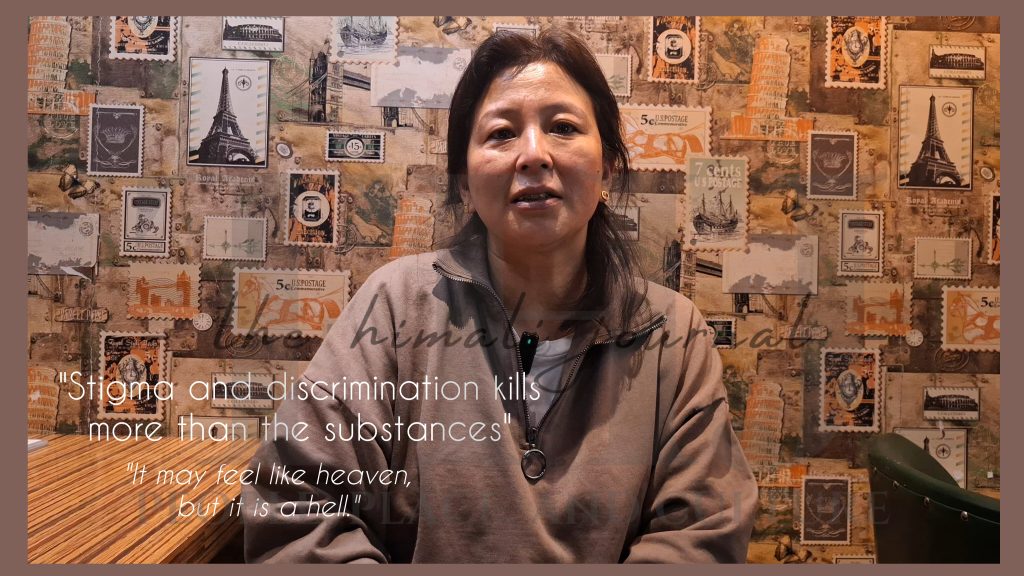
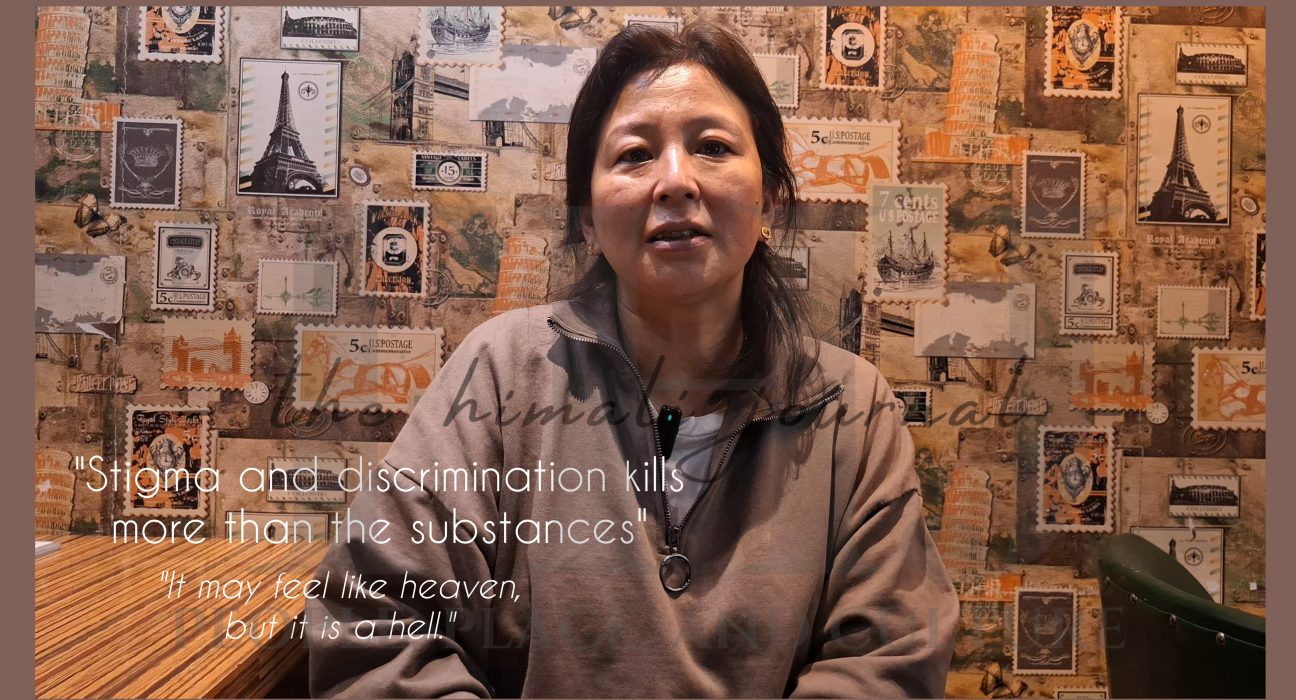
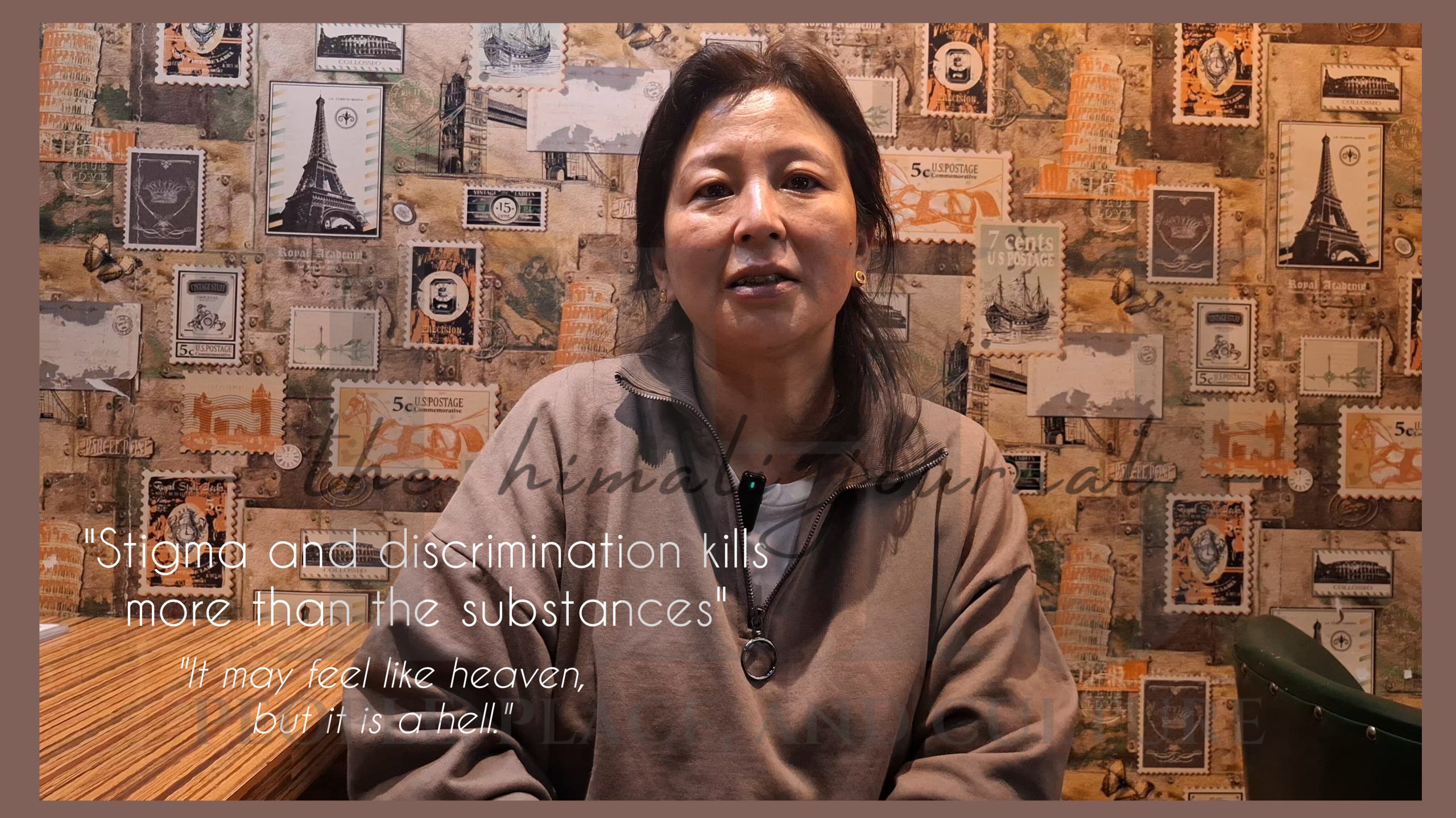
“Stigma kills more than the drugs,” she says quietly.
It is not the loudest statement in the conversation. But it is the most powerful.
Even during filming, hesitation is visible. Speaking openly is not easy. Coming forward is an act of courage. For women, that courage must fight against both addiction and society.
Character, Not Just Chemicals
Aie Rinzing offers an insight that goes beyond substance use. She believes that suffering is not caused only by drugs, but also by what she calls “character defects.” Pride. Ego. Gossip. Resentment.
“These are gateways to a hellish life,” she says. Addiction, in her view, is not just chemical dependency. It is also emotional imbalance.
Recovery, therefore, must go deeper than abstinence. It must rebuild character.
Healing Through Service
If there is one thing she credits for her recovery, it is service. Helping others. Sharing experiences. Listening without judgment.
“Service to others is a lifeline,” she says. Through service, she found purpose. Through sharing, she found healing.
Today, she works closely with women struggling with substance use. She supports them not just with advice, but with understanding. Because she has been there. Because she knows.
A Life Reclaimed
Aie Rinzing has been clean for the past 20 years.Two decades. It is a remarkable achievement. But she does not present it as victory. She presents it as responsibility. She still fears relapse.
Recovery, she believes, never ends. It continues; quietly, daily, internally.
Professionally, she has contributed significantly to advocacy and support: Served on the executive board of the Indian Drug User Forum for three years. Served as President of the Sikkim Drug User Forum (registered in 2018) for three years
Her work now focuses on supporting women. Those who are still struggling, still silent, still afraid.
Speaking to Save One Life
“By sharing about me today,” she says, “if I can save one life, that will be my biggest achievement.”
There is no ambition beyond that. No desire for recognition. No need for validation. Just one life.
In a world where addiction stories are often hidden, her voice matters. Because it speaks not only of suffering, but of survival. Not only of addiction, but of dignity.
Beyond Addiction
As the evening in MG Marg continues, the café grows quieter. Outside, the city moves as usual. Inside, stories like hers remain largely unseen. But they exist. In homes. In silence. In shadows.
Aie Rinzing’s journey reminds us that addiction is not the end of a person’s story.
And recovery is not just about stopping drugs. It is about reclaiming identity. Rebuilding relationships. Restoring dignity. And perhaps most importantly, breaking silence.
Like every recovering user we met in this series, her philosophy remains simple: Recovery is not a destination. It is a decision made every day. One day at a time.