

When Opposition Walks Away: Sikkim’s Risks of One-Party Comfort
As Sikkim marks fifty years within the Indian Union, its democratic experience reveals a recurring pattern; long phases of political dominance punctuated by moments when opposition mattered deeply, and altered the course of power. And that is why Sikkim is risking of One-Party Comfort, again.
Since 1975, Sikkim’s electoral history has been defined less by frequent alternation of governments and more by the endurance of dominant political formations.
Power has rarely been fragmented. Instead, it has moved in long arcs. From the Sikkim Sangram Parishad in the late 1970s and early 1980s, to the Sikkim Democratic Front (SDF) from 1994 to 2019, and now to the Sikkim Krantikari Morcha (SKM) since 2019.
Yet, these transitions were not accidental. Each was preceded by a phase in which opposition were often dismissed as weak or irrelevant by people.
After Sikkim’s merger with India in 1975, opposition voices during this period were limited and fragmented. By the mid-1980s, however, public fatigue with instability and internal dissensions created political space for new leadership.
The rise of Nar Bahadur Bhandari and the Sikkim Sangram Parishad (later Sikkim Sangram Parishad, SSP) culminated in electoral shifts by 1984, marking one of the early instances where opposition pressure reshaped governance.
A more decisive example came in 1994. The Sikkim Democratic Front, led by Pawan Kumar Chamling, emerged from opposition to defeat the then-ruling Sikkim Sangram Parishad. What followed was an unprecedented 25-year rule. From 1994 to 2019, which is the longest by any chief minister in India. For much of this period, opposition parties existed but struggled to seriously challenge the SDF’s political machine.
However, opposition did not disappear entirely. The formation of the Sikkim Krantikari Morcha in 2008 marked a turning point. Under Prem Singh Tamang (PS Golay), the SKM spent a decade in opposition between 2009 and 2019.
These years were marked by electoral defeats. Most notably in the 2009 and 2014 Assembly elections, but also by steady organisational expansion, grassroots mobilisation, and a narrative that positioned the party as a moral and administrative alternative to a fatigued ruling establishment.
The 2019 Assembly election validated this long opposition phase. The SKM’s victory was not merely an electoral upset; it was a democratic correction enabled by persistence in opposition.
It reaffirmed that in Sikkim, an opposition, when patient, grounded, and connected to everyday governance concerns, could still translate into power.
It is precisely this historical memory that casts recent developments in sharper relief.
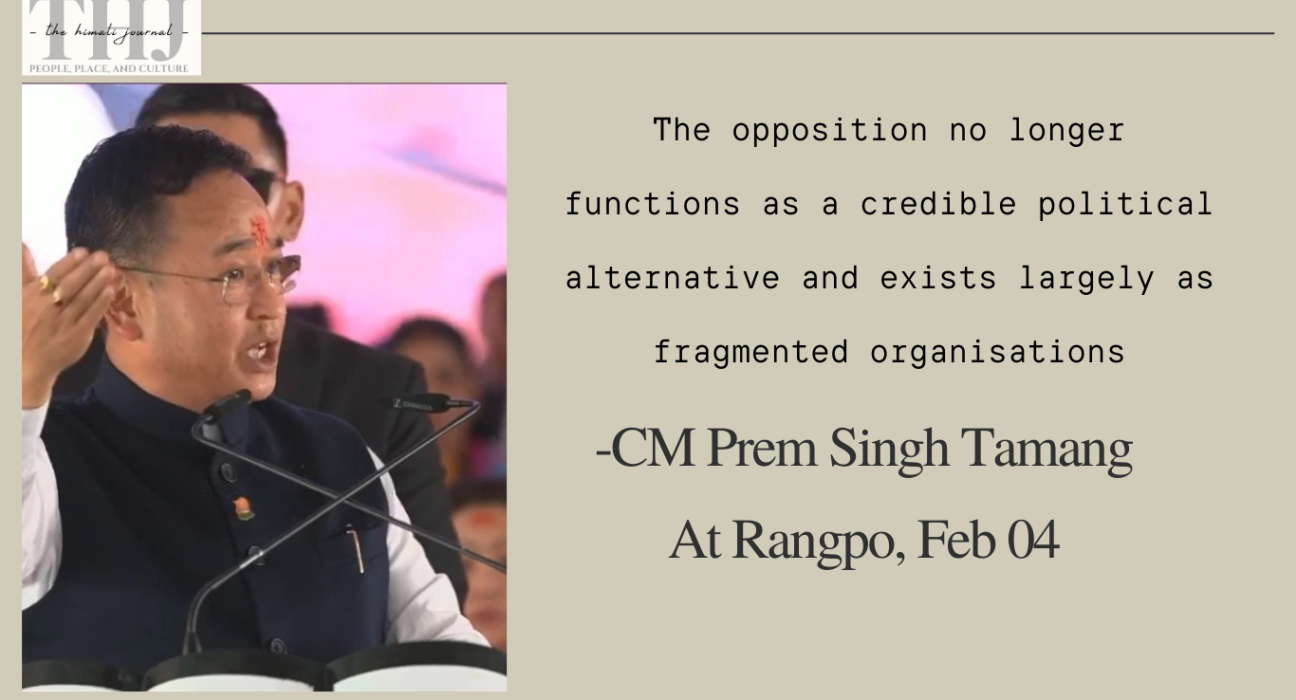
During the SKM’s 14th Foundation Day celebrations at Rangpo on February 4, 2025, nearly a hundred leaders and workers from opposition parties joined the ruling formation. Among them were former legislators and senior organisational figures.
While the event highlighted the SKM’s growing dominance, it also revived an old and unresolved question in Sikkim’s politics: what happens when opposition steadily empties out?
Addressing the gathering, Chief Minister Tamang asserted that the SKM remains ideologically open to all who believe in ‘democratic socialism’.
He also argued that the opposition no longer functions as a credible political alternative and exists largely as fragmented organisations.
The statement reflected not just confidence, but the political reality shaped by consecutive electoral mandates in 2019 and 2024 that have severely weakened rival parties.
Historically, however, similar moments of opposition collapse have carried long-term consequences. During the late years of the SDF’s rule, particularly after its sweeping victories in 2004 and 2009, defections became routine, and opposition benches grew thinner. While governance continued, political scrutiny weakened. It was only when sustained opposition re-emerged in the form of the SKM that democratic competition was restored.
The testimonials of new entrants at Rangpo suggest that today’s defections are driven less by ideology and more by a perception of futility. Several argued that criticism without influence had become politically sterile.
For many defectors, not the ruling’s governance, but grievances upon their former alliances has become their decisive metric.
In a small state like Sikkim, where policy outcomes are visible almost immediately and governance is experienced at close quarters, opposition detached from administrative power struggles to remain relevant.
SKM in last seven years has been able to translate welfare delivery, administrative restructuring, and visible leadership into its political capital.
In Sikkim’s intimate political ecosystem, performance increasingly substitutes for ideological contestation.
Yet, history cautions against mistaking dominance for permanence.
Opposition is not merely about winning elections; it is about questioning authority, preventing complacency, and imagining alternative futures.
The SKM’s own decade-long opposition between 2009 and 2019 stands as a reminder that today’s ruling party once benefited from a democratic space that allowed dissent to mature.
The concern, therefore, is not defection itself.
Political migration has been a recurring feature of Sikkim’s post-1975 history.
What is more troubling is the growing normalisation of a political culture where power outside the ruling party appears ineffective, even irrelevant.
Sikkim’s democracy has been strongest not when opposition vanished, but when it endured.
Through losses, marginalisation, and long years in the wilderness.
As the state reflects on fifty years within the Indian Union, the real test is not the strength of the ruling party, but the survival of meaningful political alternatives.
Because history suggests that Sikkim may yet need its opposition again.